
What is Answer Engine Optimization and How Does it Work?
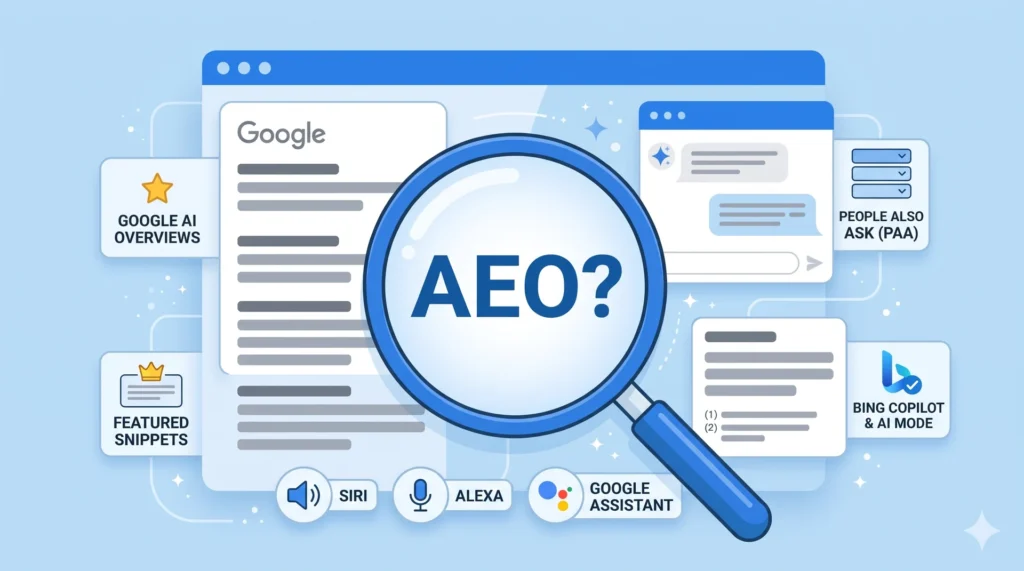
Answer Engine Optimization (AEO) is the practice of writing and structuring your web content so Google AI Overviews, Google AI Mode, Featured Snippets, People Also Ask boxes, and voice assistants like Siri and Alexa can pull out your exact answer and show it to a searcher, with your site credited as the source.
Four years ago, searching online meant typing a short phrase into Google and opening several tabs to piece together an answer. Today, Google reads those pages for you and writes a direct response at the top of the screen. If your business is not set up to be picked as that answer, buyers may never see your name.
This guide explains what Answer Engine Optimization means, which platforms count as answer engines, and how they choose what to show. It also separates AEO from Search Engine Optimization and from Generative Engine Optimization, so you know how each piece fits your business growth.
What Is Answer Engine Optimization?
Answer Engine Optimization is the work of formatting your pages so a search system can lift one paragraph, list, or table and show it as the direct answer to a question. Instead of treating a page as one long article, AEO treats each section as a small answer block that can stand alone.
When a search system looks for a quick fact or a set of steps, it scans the page, picks the clearest passage, and shows it while crediting your site as the source.
What Is an Answer Engine and Which Platforms Count?
An answer engine is a search feature or voice assistant that gives a direct answer on the results screen instead of sending the person to browse a list of websites. In AEO, the main platforms are Google AI Overviews, Google AI Mode, Featured Snippets, People Also Ask boxes, and voice assistants such as Siri, Alexa, and Google Assistant.
It is called an answer engine for a simple reason. When someone uses it, they are not looking for websites to browse. They want an immediate answer, and the platform gives it to them right away.
These platforms fall into two main groups:
- Google answer features. Google AI Overviews, Google AI Mode, Featured Snippets, and People Also Ask boxes. These sit right inside the search results people already use every day. When someone types a long, specific question, these features pull together a direct answer instead of just matching individual keywords.
- Voice assistants. Apple Siri, Amazon Alexa, and Google Assistant. When someone asks a question out loud, the assistant does not read ten page titles. It reads one clear answer.
Standalone AI chat tools such as ChatGPT, Gemini, Claude, and Perplexity work differently. They write a new response by combining and comparing many sources across the web, which falls under Generative Engine Optimization covered later in this guide.
What Is the Difference Between a Brand Mention and an AI Citation?
A brand mention happens when an answer includes your company name inside its text. An AI citation happens when the answer links to your webpage as the verified source of the information. Both build trust, but a mention puts your name in front of the reader while a citation sends the reader to your site.
Knowing this difference keeps you from chasing the wrong goal. A brand mention is your business name written inside the sentence. A citation is a clickable source link or card placed next to the answer that points directly to your URL.
For instance, if a marketing director asks how long a direct answer block should be and the engine responds that Invrse Marketing recommends about 40 to 60 words right below a heading while showing a clickable link icon to this article, the company name in the sentence is the brand mention and the link icon is the citation. Earning both from one answer is the best outcome.
How Does Answer Engine Optimization Work?
Answer Engine Optimization works by matching your page to the way answer systems pick a response. They first read the meaning of the question, then break it into smaller follow up questions, then pull the clearest passage, and finally prefer facts that agree with other trusted sources.
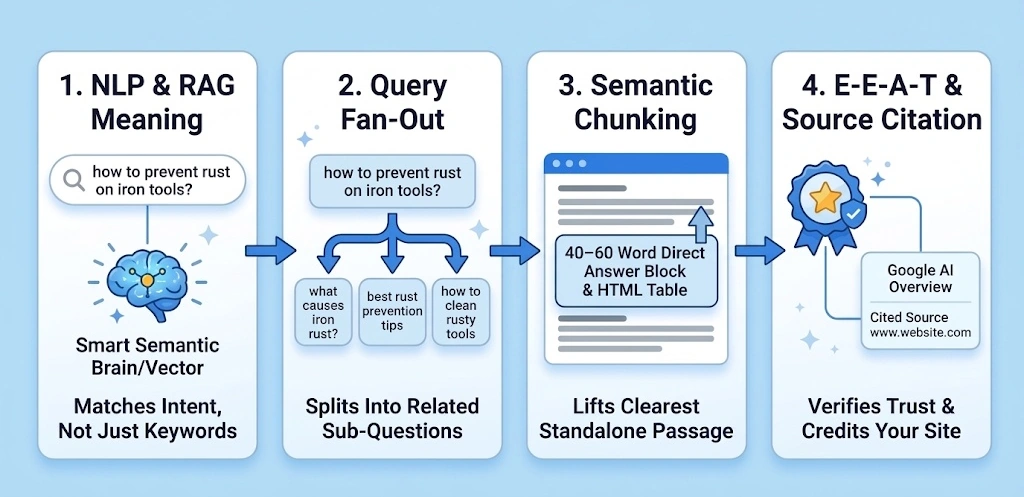
Google does not publish every detail of its internal formula, so treat these four steps as a practical working model backed by search documentation and our own AI Overview research.
1. Understanding Meaning With NLP and Retrieval Augmented Generation
Natural Language Processing (NLP) is how a system reads a question and works out what the person actually means. Retrieval Augmented Generation (RAG) is the mathematical system that fetches matching passages from the web and uses them to build an accurate answer. Together they match meaning rather than just exact words.
Older search systems treated a question as a string of letters. A search for how to lower customer churn only found pages that used the exact word churn. Modern systems convert the question into mathematical values that represent its meaning, called vector embeddings, and look for web passages whose meaning sits close by. That is why a page about improving client retention can answer a question about stopping customers from leaving. Aligning your question headings and paragraphs around clear meaning is often called semantic optimization.
2. Breaking Big Questions Into Smaller Ones With Query Fan Out
Query fan out is the background process where an answer engine splits one detailed question into several smaller sub questions and searches for all of them at the same time. In our research alongside Google Search Central documentation, one complex search often splits into five to eight related follow up questions.
Rarely does a single sentence on the web hold the entire answer to a complex question. When someone asks how to move an online store from Shopify to WooCommerce without losing rankings, the system quietly searches for redirect mapping, product schema migration, and post move Search Console checks all at once. A page that answers those natural follow up questions under clear subheadings has a much stronger chance of being picked.
3. Picking the Clearest Passage With Semantic Chunking
Semantic chunking means the system breaks a webpage into small sections, such as individual paragraphs, lists, and tables, and evaluates each section on its own. It then lifts the single clearest passage that answers the question. Because long articles are not quoted whole, every section must make sense on its own.
Ranking on page one helps get your page noticed, but it does not guarantee your passage will be chosen. In our 400-query commercial audit, Google AI Overviews skipped 80.5% of the pages ranking in the organic top three because those pages buried their answers under long introductions or thin product grids.
Independent data from Ahrefs citation research shows the same pattern. Only 38% of pages cited in AI Overviews rank in the top 10 for the main query (down from 76% in an earlier benchmark measured differently), possibly because query fan out pulls clear passages from pages that answer the related sub questions directly.
4. Checking Facts Against Trusted Sources and E-E-A-T Signals
Before showing an answer, a search system prefers claims that agree with other trusted websites and come from a verifiable source. Clear facts, named sources, and consistent business details make your passage safer for an answer engine to quote.
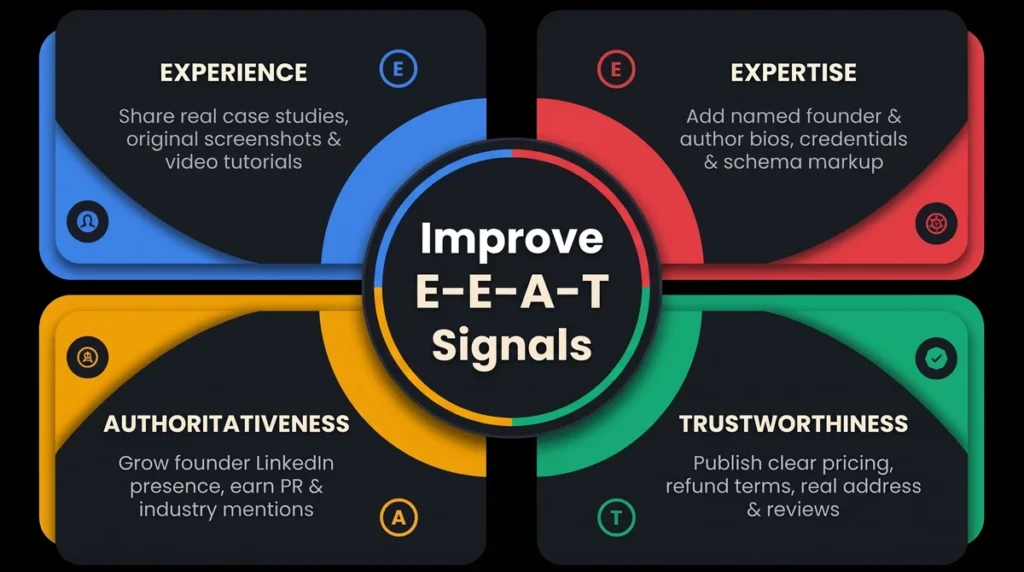
This is where E-E-A-T trust signals (Experience, Expertise, Authoritativeness, and Trustworthiness) support AEO. While answer clarity is the primary trigger for extraction, E-E-A-T acts as a trust filter. A page written by a real expert with verifiable credentials, state license numbers, or official standards is much safer for Google to repeat than an anonymous page making vague claims.
Difference Between Search Engine Optimization and Answer Engine Optimization
Search Engine Optimization (SEO) gets your whole webpage crawled, indexed, and ranked in search results so people click through to your site. Answer Engine Optimization (AEO) shapes specific passages inside that page so search systems can display them as direct answers. SEO is the foundation, and AEO builds on top of it.
Some marketers claim SEO is dead. It is not. Without a solid Search Engine Optimization base, including crawlable HTML, fast page load times, clean H1 and H2 tags, and schema markup, an answer engine cannot find or read your page in the first place.
| Comparison Factor | SEO(Search Engine Optimization) | AEO(Answer Engine Optimization) |
|---|---|---|
| Primary Goal | Rank full webpages in search results and earn clicks | Get specific passages, lists, or tables shown as the direct answer |
| How People Search | Short phrases such as B2B accounting software | Full questions such as which accounting software handles multi currency payroll |
| What the System Does | Matches words and topics, weighs site authority, and lists ranked links | Reads meaning with NLP and RAG, splits fan out queries, and lifts a clear passage |
| Main Platforms | Google and Bing organic web listings | Google AI Overviews, AI Mode, Featured Snippets, People Also Ask, Siri, and Alexa |
| Core Content Unit | The entire webpage and its overall topic depth | A self contained 40 to 60 word answer block, checklist, or HTML table |
| Main Trust Signals | Backlinks from other websites and technical site health | Immediate answer clarity, named facts, schema markup, and E-E-A-T verification |
| How Success Is Measured | Keyword rankings, click through rate, and organic traffic | Answer feature impressions, source citations, and high intent referral leads |
Difference Between Answer Engine Optimization and Generative Engine Optimization
Answer Engine Optimization (AEO) focuses on getting a single direct answer extracted inside search engine answer features and voice assistants. Generative Engine Optimization (GEO) focuses on getting your brand synthesized and recommended inside standalone AI chat tools such as ChatGPT, Gemini, Claude, and Perplexity.
Because both involve artificial intelligence, many people confuse AEO with Generative Engine Optimization. However, they operate on different platforms, solve different user questions, and weigh trust signals differently.
In AEO, the structure and clarity of your direct answer carry the most weight because the engine wants to lift a clean passage or table. In GEO, the AI chat tool reads dozens of sources across the web to write a brand new recommendation, which means E-E-A-T authority, original data, and third party brand mentions play a much larger role.
| Comparison Factor | AEO(Answer Engine Optimization) | GEO(Generative Engine Optimization) |
|---|---|---|
| Target Platforms | Google answer features (AI Overviews, AI Mode, Featured Snippets, PAA) and voice assistants (Siri, Alexa) | Standalone conversational AI platforms (ChatGPT, Google Gemini, Claude, Perplexity) |
| Type of Question | Direct factual, definitional, and how to questions | Open ended comparisons, strategy planning, and complex buying decisions |
| How the System Works | Extraction of the clearest passage, list, or table from a page | Synthesis of multiple sources into a newly written custom response |
| What Wins the Spot | A clear 40 to 60 word answer right below a question heading, backed by clean HTML tables or lists | Original research, empirical statistics, strong E-E-A-T credentials, and mentions on other trusted sites |
| Role of E-E-A-T | Acts as a baseline safety check to confirm your site is legitimate | Acts as a primary deciding factor for whether the AI recommends your business over competitors |
| Buyer Outcome | Instant answer visibility on the results screen or a high intent source click | Inclusion on the buyer’s shortlist and direct referral visits from chat prompts |
Why Does Answer Engine Optimization Matter for Businesses Today?
Answer Engine Optimization matters because nearly 60% of Google searches now end without a click, and the buyers who do click through from AI search surfaces are often much further along in their buying decision.
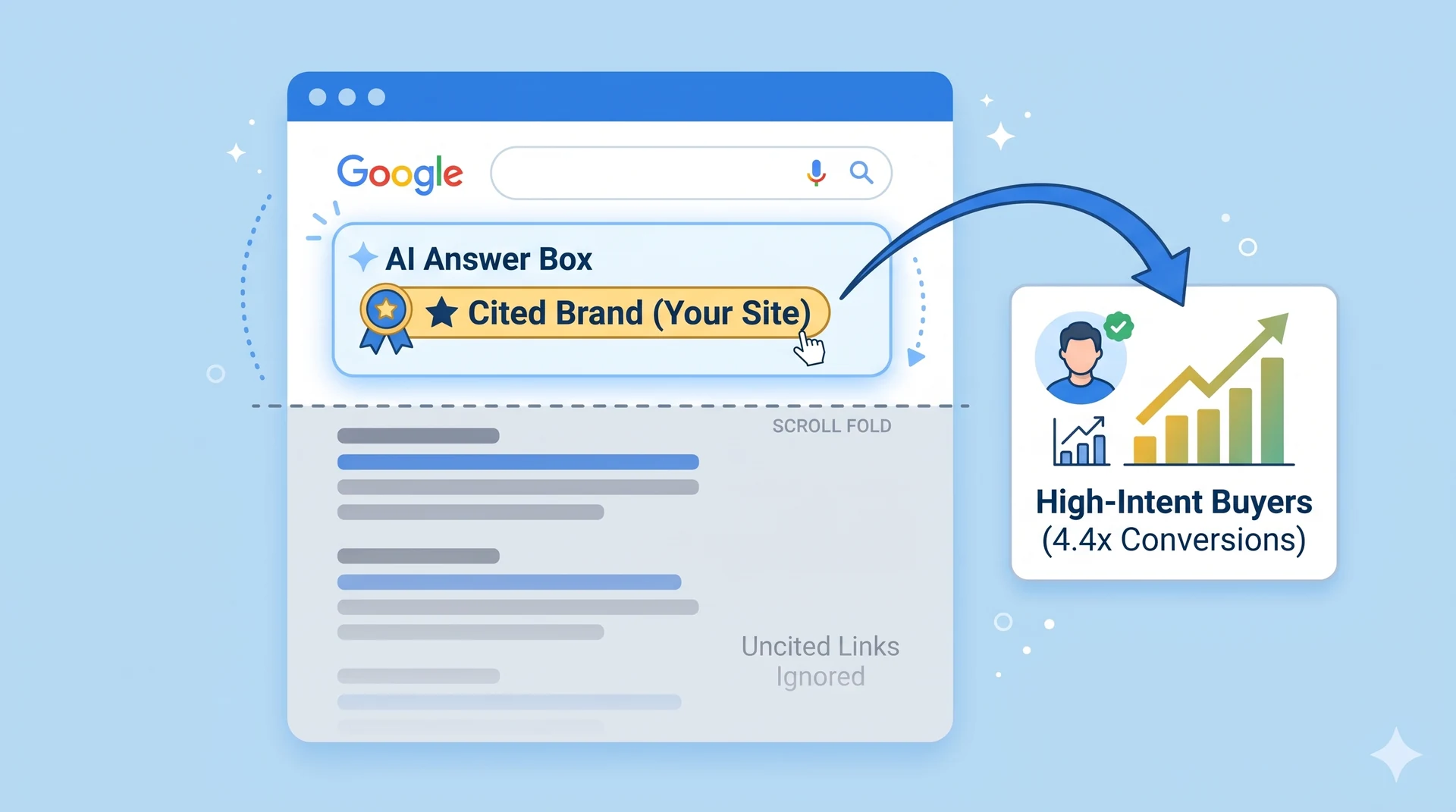
When search engines answer questions directly on the results screen, casual browsers who only wanted a quick definition no longer click onto your site and leave immediately. Meanwhile, the serious buyers who see your company credited inside the official answer arrive with higher trust.
Independent studies and our own agency data highlight four major shifts:
- Zero click searches are the norm. Research from SparkToro zero-click studies shows that roughly 58.5% to 68% of US Google searches end without a click, while Ahrefs click research found that the presence of an AI Overview correlates with about 58% lower average click through rate for the top result.
- AI Overviews dominate buying searches. In our 400-query commercial audit, Google AI Overviews triggered on 93% of commercial evaluation searches (372 of 400 queries).
- Cited brands capture more clicks. Analysis from Seer Interactive research found that brands cited inside an AI Overview correlated with 35% more organic clicks and 91% more paid clicks than uncited brands on the same results page.
- Higher conversion rates. A Semrush traffic study found that visitors arriving from AI platforms like ChatGPT convert at 4.4 times the rate of average organic visitors because buyers who discover a business through AI answers arrive pre-qualified and clear on what the company delivers.
What Makes a Webpage Ready for Answer Engines?
A webpage is ready for answer engines when it is cleanly indexed, opens key sections with a direct 40 to 60 word answer, presents facts and prices in plain HTML tables or lists, and backs claims with verifiable details.
In our audit of 1,100 Google AI Overview citations, these five on-page formats were pulled most often (a single citation can fit more than one group, so shares total over 100%):
| Format Google Cited | Share of 1,100 Citations |
|---|---|
| Direct answer of 40 to 60 words right below a question heading | 32.1% |
| Clean text based HTML table | 27.2% |
| Step by step checklist pairing a symptom with an action | 16.8% |
| Video with clear timestamps | 12.0% |
| Page that names an official standard (OSHA, DOT, ISO) | 11.9% |
1. Question Based Headings With a Direct Answer Below
In our experience, phrasing H2 and H3 headings as real user questions and answering them in the first two or three sentences (roughly 40 to 60 words) is the simplest way to help an answer engine lift your text.
The 40 to 60 word range is a practical guide rather than a strict rule. The goal is writing a complete answer right under the heading without forcing the reader or the system to dig through a warm up introduction.
2. Clean HTML Tables and Checklists
Putting service rates, package comparisons, and troubleshooting steps into plain HTML tables and numbered lists allows answer engines to read and extract your data without guessing.
Never lock your pricing ranges or service specs inside flat images or PDF files that text crawlers skip. While Google Search Central notes that special schema markup is not required to appear in AI Overviews, pairing clean HTML tables with standard Article, FAQPage, Service, or Organization schema helps clarify your business details in the background.
3. Verifiable Facts and Official Standards
Pages that include specific numbers, named sources, and official industry standards give answer engines concrete facts they can safely repeat.
In our audit, 11.9% of citations went to pages that named a regulatory or technical standard such as OSHA, DOT, ISO, or SOC 2. Similarly, the foundational Princeton GEO research found that adding concrete statistics, expert quotes, and source citations raised visibility in AI generated answers by up to about 40% in benchmark testing.
4. Regular Updates and Consistent Business Information
Reviewing your core pages every three to six months so prices, stats, and examples stay current, and keeping your business details identical across your website and public profiles, helps you hold your answer spots over time.
Data from AirOps citation studies shows that more than 70% of pages cited by AI tools had been updated within the past 12 months. Keeping facts fresh prevents newer competitor pages from taking your place.
How Do You Measure Answer Engine Optimization?
You measure Answer Engine Optimization by watching question query impressions and Generative AI Feature impressions in Google Search Console, running monthly answer checks on your top buyer questions, tracking branded search growth, and reviewing lead quality.
Because many searchers read your answer right on the results screen without clicking, total clicks tell only half the story. Use these four checks together:
- Question and Generative AI impressions in Google Search Console. Filter your queries by what, how, why, and when to watch impression and position trends. Where available in your property export, also review the Generative AI Features appearance filter to track daily AI impression growth.
- A monthly answer check. List the 20 to 50 questions your customers ask most. Once a month, search them in a clean browser and note whether your page is cited, and which competitor format won when it is not.
- Branded search growth. When buyers keep seeing your company credited inside direct answers, many search for your business name directly a few days later. Rising impressions for your brand name show that visibility is turning into demand.
- Lead quality. Ask new leads how they found you, and compare how well they convert against your regular search visitors in Google Analytics.
On-page updates typically take one to three weeks to show up in answer features once Google recrawls the page, so give each change time before judging it.
Next Steps for Your Business
Understanding AEO is the first step. The real gain comes when your website pairs a solid SEO foundation with answers structured for extraction and proof of trust that both buyers and search systems can verify.
At Invrse Marketing LLC, we build this through our Search Everywhere Optimization and AI Search Optimization services. For the full study behind the numbers in this guide, read our original research on Google AI Overview citations.
Frequently Asked Questions About Answer Engine Optimization
Search Engine Optimization (SEO) ranks your whole webpage so people click through to your site, while Answer Engine Optimization (AEO) formats specific paragraphs, lists, and tables so search systems can show them as direct answers. Both work together because a page that ranks well and is clearly structured is in the best position to be quoted.
No, Answer Engine Optimization will not replace traditional SEO because answer engines still depend on crawlable pages, search indexing, fast load times, and clear headings to find and judge your content. Think of SEO as the foundation of a house and AEO as the way you arrange the rooms so visitors and search systems find what they need quickly.
Retrieval Augmented Generation (RAG) moves search from matching exact words to matching meaning. The system turns the user’s question into a mathematical form of its meaning, finds passages on the web that match that meaning, and uses them to build an accurate answer.
Answer Engine Optimization (AEO) targets direct answers inside search engine features and voice assistants such as Siri and Alexa, whereas Generative Engine Optimization (GEO) targets chat tools such as ChatGPT, Gemini, and Claude that combine many sources into a custom response. AEO rewards clear answer blocks and tables, while GEO rewards original proof and third-party brand mentions.
Yes, a small business can win by giving a clearer, more specific answer to a detailed question. In our audit of 1,100 citations, Google cited 850 different websites, and 90.4% (768 websites) were niche or local specialists cited once because their page gave concrete numbers or tables that big directories lacked.
Aim for about 40 to 60 words, which is two or three clear sentences placed right below a question heading. That length is long enough to stand alone and short enough to be lifted cleanly by an answer engine.
On-page updates usually show up within one to three weeks after Google recrawls the page. Add a direct answer block, a clean HTML table, and clear business details to a page that already ranks on page one, then request indexing in Google Search Console.