
What Is Generative Engine Optimization and How Does It Work?
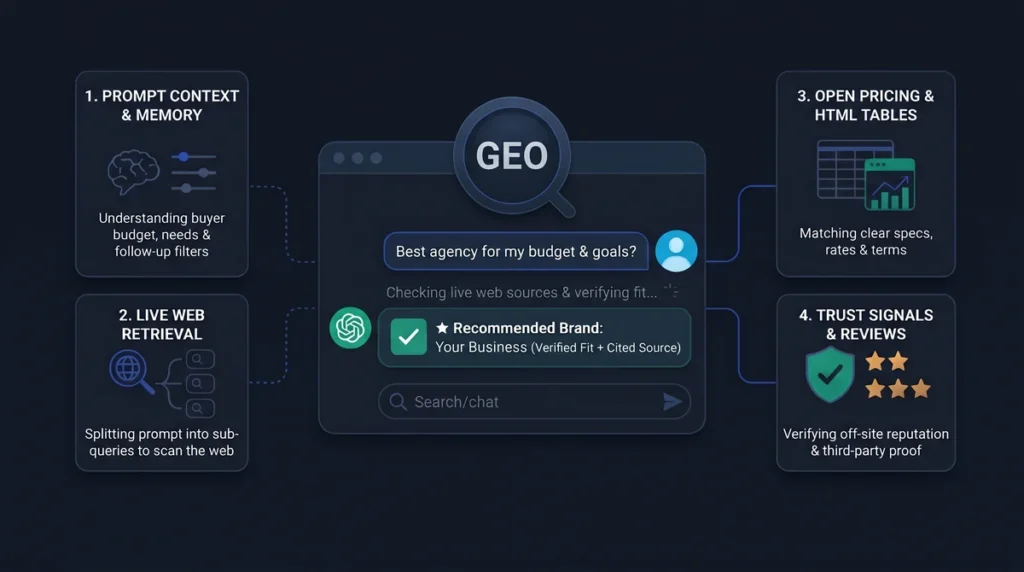
Generative Engine Optimization (GEO) is the practice of optimizing your business or brand for conversational AI platforms like ChatGPT, Perplexity, Google Gemini, Claude, and Microsoft Copilot. Because these systems are conversational AI rather than static search bars, they work by understanding each user’s specific needs and chat context, fetching live evidence across your online footprint, and generating a custom answer tailored to that individual user.
What Is Generative Engine Optimization?
Generative Engine Optimization is the work of making your business easy for AI assistants to understand, verify, and confidently recommend when a buyer’s needs match what you offer.
Think about the last time you started a new project or needed a tool or service. Chances are you opened ChatGPT, Gemini, or Perplexity and asked for advice. If you asked an AI to suggest a tool that writes content for you, the brands it named appeared because of Generative Engine Optimization.
GEO is not about optimizing a single webpage for a keyword. It is about making your business model, product capabilities, and reputation clear across the web, so a conversational AI assistant is comfortable putting your name in front of a buyer. The assistant is not matching words. It is deciding whether you are the right fit for this particular person.
Why Optimizing Your Brand for Generative AI Is Important
Optimizing for generative AI matters because buyers now build their shortlist inside an AI conversation before they ever open a website, and a business that is missing from that conversation is missing from the decision.
Your audience no longer searches only on Google. They talk with AI in a two-way conversation, explain their needs, test options, and look for the best match. When an AI explains your offerings to a potential client on your behalf, that buyer has an immediate reason to trust you. If your business does not appear there, you miss today’s biggest search opportunity. Here is what is at stake:
- You gain better-qualified buyers. Someone who clicks through from an AI recommendation has already told the AI their requirements, and the AI has matched them to you. A Semrush AI search traffic study found that these visitors convert at about 4.4 times the rate of ordinary organic visitors.
- You lose the shortlist if you are absent. You can rank on page one of Google and still stay invisible to a buyer who filters their options inside ChatGPT or Gemini first. If the AI does not trust or retrieve your business, the buyer never sees your name.
- You cast a wider net. Optimizing for generative AI means strengthening your website, directories, social channels, communities, and video presence. That wider footprint naturally strengthens your Search Everywhere Optimization footprint, lifting traditional search rankings and answer engine visibility at the same time.
How Generative Engine Optimization Works Behind the Scenes
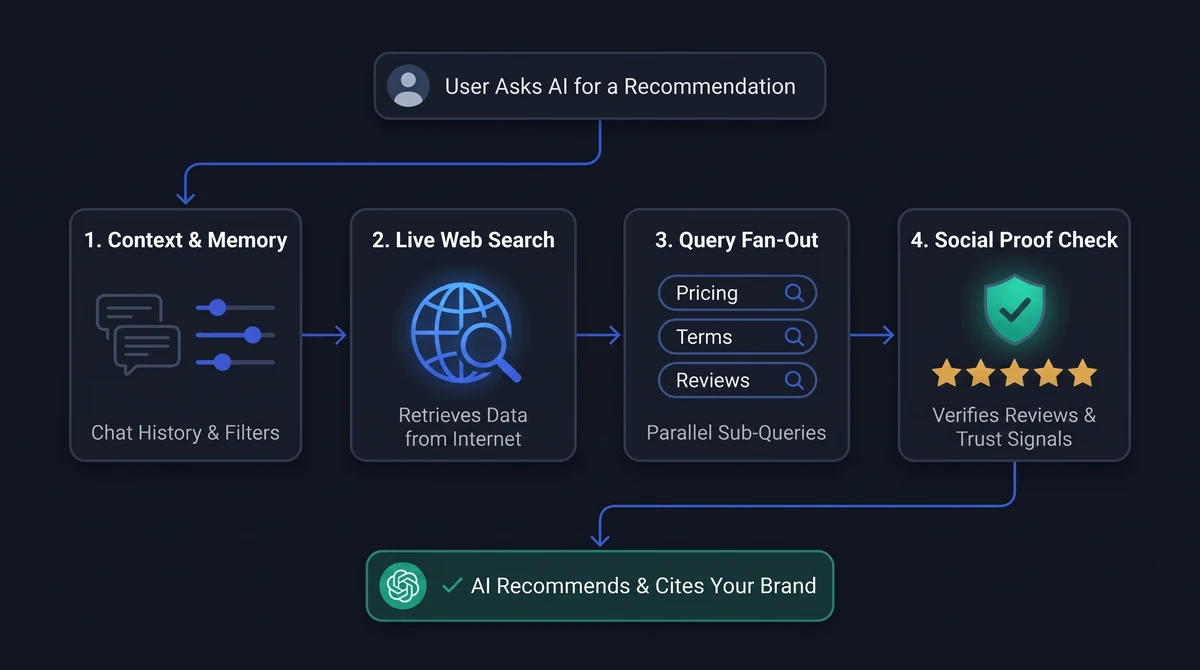
Generative Engine Optimization works by matching your online presence to a five-step process AI runs in seconds: it reads the buyer’s full context, decides whether to search the web, splits the request into smaller searches, ranks the best passages, and writes a recommendation it can verify.
To see how this five-step pipeline works in practice, each step below pairs a realistic buying scenario with what we saw firsthand when testing how AI engines evaluate businesses.
Step 1: The AI Reads Your Prompt and Everything It Knows About You
Unlike a three-word search, a generative AI reads the buyer’s full multi-sentence prompt, their earlier messages, their location, and their saved preferences before it looks for an answer.
In our tests, brands that led the first answer regularly vanished by the third turn when a new condition disqualified them—such as a $99 introductory offer whose renewal jumped to $159 (above a $135 budget cap), or a $3/month telecom plan whose terms banned commercial use. Across repeated ChatGPT sessions, the shortlist dropped from five options to one after a single follow-up.
Step 2: The AI Decides Whether to Answer From Training Knowledge or Search the Web
For timeless questions the AI answers from memory, but for current services, pricing, and recommendations it uses Retrieval Augmented Generation (RAG) to fetch live web pages first.
Live page retrieval matters because search snippets are often outdated. In our tests, Perplexity and Claude initially misquoted a provider’s mail-forwarding fee at $20/month from stale snippets before opening the live page and correcting it to $49/year, while ChatGPT and Perplexity caught a 1,000-contact legal limit on a free CRM plan that partner blogs falsely advertised as 1,000,000 contacts.
Step 3: The AI Breaks Your Prompt Into Smaller Search Queries
Because no webpage matches a long personal request word for word, the AI uses Query Fan Out to split it into several smaller searches and runs them all at once.
Across our 330 prompts we logged more than 1,800 background searches. If any subpage or review uncovered in those side searches contradicts the buyer’s criteria, the AI removes your brand silently without warning.
Step 4: The AI Retrieves and Ranks Sources and Passages
The AI slices each candidate page into small blocks, such as paragraphs, lists, and tables, and scores how well each block’s meaning matches the buyer’s need.
This extraction stage is called semantic chunking. Rather than counting keyword frequency, the engine evaluates individual paragraphs, lists, and HTML tables to score how clearly each block answers a specific requirement.
noindex landing pages that were not blocked in robots.txt.Step 5: The AI Writes the Answer and Chooses What to Cite or Recommend
The AI combines the strongest passages, checks whether independent sources back up your claims, and then writes its recommendation with brand mentions and clickable citations.
Difference Between Generative Engine Optimization (GEO) and Search Engine Optimization (SEO)
Search Engine Optimization (SEO) is the technical foundation that gets individual webpages crawled, indexed, and ranked in search results to earn clicks. Generative Engine Optimization (GEO) builds on that foundation by evaluating your entire business entity—your offer, pricing, legal terms, founder credibility, and third-party reviews—to recommend your brand inside AI conversations.
| Comparison Factor | Search Engine Optimization (SEO)(Page-Level Organic Ranking) | Generative Engine Optimization (GEO)(Whole-Business AI Recommendation) |
|---|---|---|
| Unit of Competition | Single webpage URL competing for a ranking slot | Entire business entity, offer, and reputation across the web |
| Primary Goal | Rank full webpages in organic search results to earn clicks | Get your brand verified, cited, and recommended inside AI answers |
| How Buyers Search | Short phrases typed into a search bar, followed by opening ten tabs to compare | Detailed multi-sentence prompts with stacked budget and feature filters |
| How the System Works | Crawling, indexing, and ranking complete webpages | Query fan-out, live RAG passage retrieval, and cross-web verification |
| Impact of Fine Print & Reviews | A page with strong backlinks can rank #1 even with confusing renewal terms or weak reviews | AI cross-checks terms pages, fee schedules, and Trustpilot/BBB reviews—dropping mismatched brands |
| Main Trust Signals | Backlinks, technical site health, and page topic relevance | Founder and brand clarity, consistent pricing/terms, and independent mentions |
| Content Structure | Full keyword-aligned articles and service pages | Clear 40–60 word section leads, open HTML comparison tables, and verifiable specs |
| Success Metrics | Keyword rankings, search impressions, and organic clicks | Prompt share of voice, citation rate, answer accuracy, and AI referral leads |
Are Answer Engine Optimization (AEO) and Generative Engine Optimization (GEO) the Same Thing?
No. Answer Engine Optimization (AEO) focuses on getting a single 40-to-60-word passage or table extracted to answer a one-time question in search features like Google AI Overviews or Featured Snippets, whereas GEO focuses on getting your entire business matched and recommended across multi-turn AI conversations.
| Comparison Factor | Answer Engine Optimization (AEO)(Single-Passage Extraction) | Generative Engine Optimization (GEO)(Full-Entity Recommendations) |
|---|---|---|
| User Interaction | A single, one-way lookup looking for an immediate direct answer | A two-way conversation where buyers stack follow-up budget and feature filters |
| What Gets Evaluated | Whether one 40-to-60-word passage or table on a single page answers the query | Whether your whole business entity, offer, pricing, and reputation fit the buyer |
| Fit vs. Extraction | Your article can win the snippet even if your service model does not fit that reader | If your pricing, quota, or contract terms fail any follow-up filter, your brand is dropped |
| Main Platforms | Google AI Overviews, Bing AI Overviews, Featured Snippets, People Also Ask, Siri, and Alexa | ChatGPT, Perplexity, Google Gemini, Claude, and Microsoft Copilot |
| Core Optimization Lever | Question-style headings, concise answer blocks, and clean FAQ formatting | Founder and brand footprint, open comparison tables, consistent terms, and off-site proof |
| Buyer Outcome | Instant visibility and a source citation at the top of search results | A direct vendor recommendation and a place on the buyer’s final shortlist |
In short, AEO depends on a single passage to make your page the answer to a one-time question, while GEO depends on your entire business entity to make your brand the recommendation in a multi-step buying decision.
What Research Reveals About Getting Cited and Recommended by AI
Our research shows that AI recommends the business that best fits the buyer’s stated needs and holds up under verification, not simply the one with the most polished page or the highest Google ranking.
To test how AI engines choose recommendations, we ran 330 multi-turn buyer prompts across 90 fresh sessions on ChatGPT, Gemini, Perplexity, and Claude—evaluating roughly 15,600 source captures across 2,200 websites and manually inspecting over 6,000 live pages. Cross-referencing our findings with our Google AI Overview citation research, the Princeton GEO study, and the Ahrefs AI citation study revealed seven core patterns:
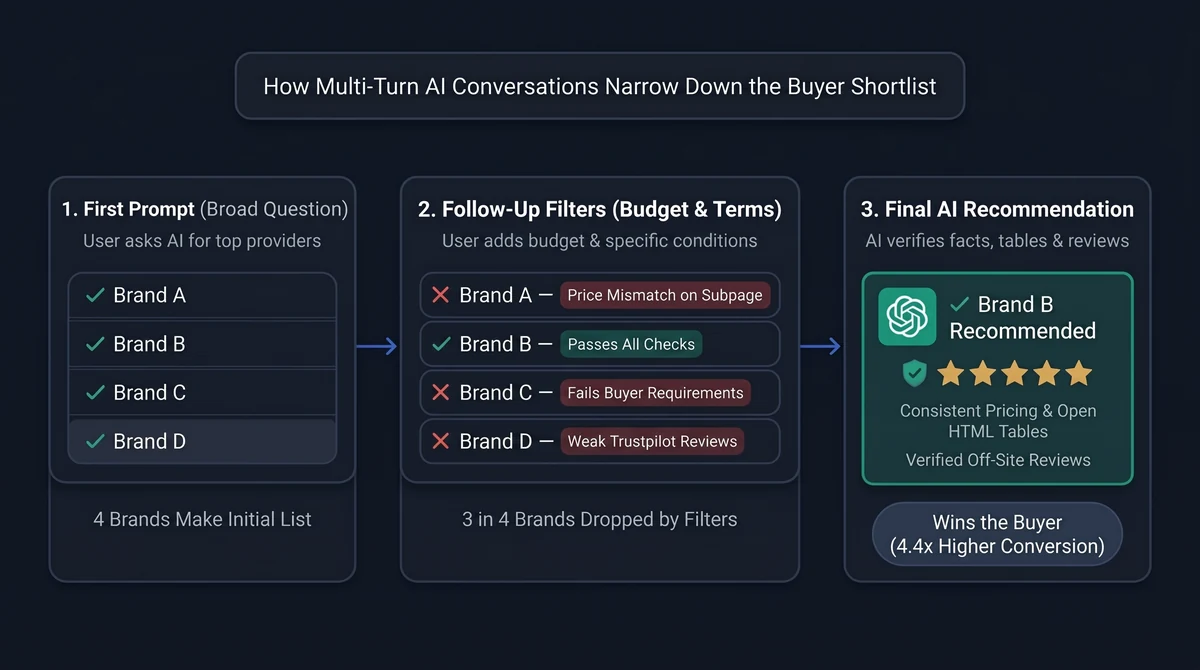
- Being retrieved is not being chosen: Out of ~15,600 source evaluations pulled by the AI, only about 1 in 4 (~3,800) were cited—the rest were filtered out once their specs failed a buyer requirement.
- Tables break ties, but offer fit wins: HTML tables appeared on 34% of cited pages versus 37% of skipped pages—acting as a strong tie-breaker when two offers match, but never rescuing a mismatched offer.
- Official brand pages drive 60% of citations: Roughly 6 in 10 citations came from official pricing, help-center, and terms pages, compared to ~25% from third-party articles and ~15% from review and community sites.
- Cross-page consistency protects your spot: Brands whose homepage promises contradicted their subpages or legal terms (such as advertising “40 daily credits” on a card while capping users at 20/day in the rules table) were dropped during fee checks.
- Independent reviews settle close calls: When two providers matched the buyer’s criteria equally, engines weighed third-party sentiment—separating self-hosted 5-star claims from 1.5/5 to 2.4/5 Trustpilot or BBB complaints.
- AI crawlers read beyond Google’s index: Across 66 citations, AI models read and cited public
noindexpages (including paid landing pages and legal terms) wheneverrobots.txtallowed access. - Verifiable facts beat keyword repetition: In the Princeton GEO benchmark, adding concrete statistics, quotes, and named sources lifted AI visibility by 30% to 40%, while keyword stuffing reduced it by ~10%.
Core Strategic Pillars to Optimize Your Business for Generative AI
Optimizing for generative AI rests on five connected pillars: keep your pages crawlable, build a clear footprint for the person behind the business, match real buyer requirements, publish consistent open facts, and grow your presence beyond your own website.
Make Sure Search and AI Systems Can Crawl and Index Your Pages
Before an AI can quote or recommend you, its crawlers must be able to reach and read your pages.
Check your robots.txt file and firewall settings, such as Cloudflare, so that major crawlers like Googlebot, Google-Extended, Bingbot, GPTBot, ChatGPT-User, PerplexityBot, and ClaudeBot are allowed. Keep your core service details and pricing in plain HTML rather than behind scripts bots cannot run. And remember that a noindex tag alone does not stop every AI bot from reading a public page, so block what you truly want private.
Prioritize the Person Behind the Business Before the Brand
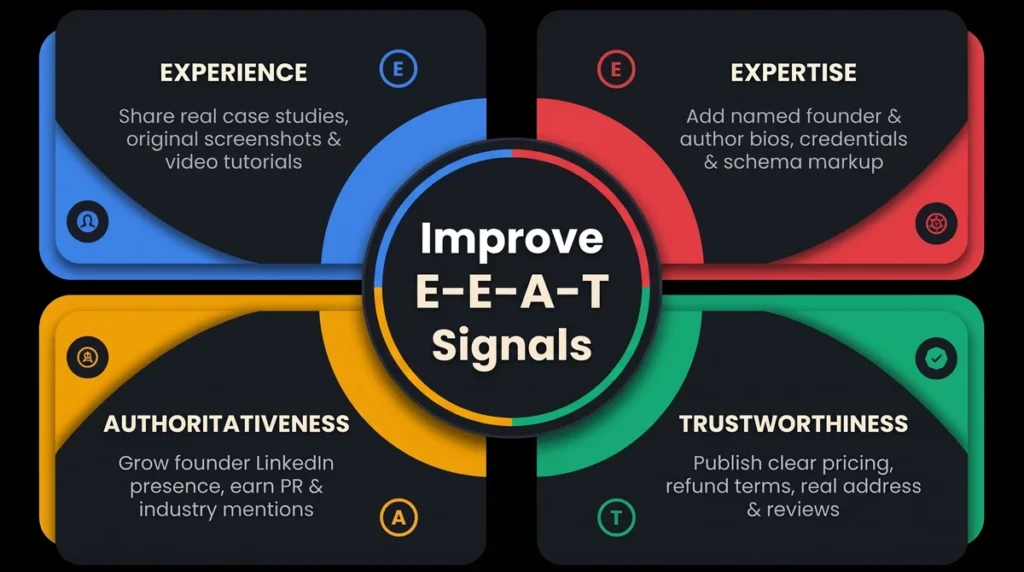
Your first priority is a clear, authentic digital footprint for the real person behind the business, because both people and AI trust a visible human before a faceless brand.
Align Content With Real Buyer Conversations and Requirements
Build your pages around the specific conditions buyers state in AI conversations, because the AI filters out anyone who does not meet them.
A business owner tired of wasted ad spend does not simply ask an AI assistant for “an advertising agency”—they ask for one that sets up conversion tracking and reports on actual revenue. When your service pages address those exact requirements, the AI has concrete proof to keep you on the shortlist; when they only list broad services, your brand gets filtered out the moment the buyer adds a condition.
Publish Open Machine-Readable Facts and Comparison Tables
Clear, consistent facts and plain HTML comparison tables give AI concrete proof of your claims, and removing contradictions across your pages protects your spot on the shortlist.
Publishing an open HTML table comparing service deliverables, pricing tiers, and contract terms gives both buyers and AI crawlers ready-to-verify evidence. Just as importantly, audit your rates, quotas, and cancellation rules across every URL so your homepage, subpages, and legal terms never contradict each other during follow-up checks.
Build a Strong Off-Site Digital Footprint Across the Web
AI checks what the rest of the internet says about you before it recommends you, so your reputation outside your website often decides the final choice.
Digital PR, such as pitching expert insights through platforms like Connectively, and authoritative guest posts are the strongest accelerators of off-site authority. In our tests, review sites and other independent sources were what settled the recommendation when two businesses looked equally strong.
If you are an early-stage business without a PR budget, start with these six steps:
- Publish original, link-worthy content such as helpful guides or small data breakdowns.
- Keep clean, complete profiles on directories like Clutch, GoodFirms, Trustpilot, and BBB.
- Stay active on LinkedIn, Facebook, and Instagram where real users engage.
- Answer buyer questions on Reddit and Quora, where AI pulls community answers.
- Join podcasts and publish YouTube videos with clear timestamps so AI can index them by topic.
- Connect every profile inside your website’s sameAs schema so AI links each signal back to your brand.
How to Measure Generative Engine Optimization Performance
You measure GEO by combining AI visibility tools with a hands-on buyer-persona test, then tracking referral traffic and branded search growth over time.
- Use AI visibility and analytics tools. Tools like Ahrefs Brand Radar and the Semrush AI Visibility Toolkit show how often AI platforms mention and cite your brand compared with competitors. Pair them with Google Search Console for branded search trends and GA4 for referrals from AI platforms.
- Run a multi-turn buyer test. A single short prompt tells you very little, because our research showed that the business leading the first answer can lose by the last one. Open a separate AI account set up as your ideal buyer, then hold a conversation of three or four turns, adding real budget and feature conditions as they would.
- Study the gap. Note whether your brand survives to the final answer, which competitors rank ahead of you, and what proof or consistency your site is missing. Then fix those gaps on your pages and profiles.
If you want a team to audit how AI platforms see your business, founder MD Mizanur Rahman and the team at Invrse Marketing can help through AI Search Optimization, Search Everywhere Optimization, and Search Engine Optimization.
Frequently Asked Questions About Generative Engine Optimization
Yes and no, because both answers are right depending on what you look at. Traditional SEO methods, including technical health, on-page structure, and off-page authority, remain the foundation AI relies on. What is being replaced is buyer search behavior. Instead of typing keywords into Google and clicking ten sites one by one, buyers now talk to AI to shortlist providers first, then visit websites to verify key details.
Each AI platform uses a different search index and verification style, and each tailors answers to the user’s chat history, location, and filters. In our tests, ChatGPT behaved like a strict terms-and-complaints auditor that cross-checked official fee schedules, quota limits, and Trustpilot versus G2 review splits; Gemini leaned heavily on Google’s index, structured schema, and plain-HTML scroll-to-text passages; Perplexity pulled heavily from live web snippets, terms pages, and community threads; and Claude searched via Brave snippets first before shifting its recommendations sharply once compelled to open and read live legal and pricing pages directly.
Yes. A small business can win by matching buyer requirements, keeping its facts consistent, publishing clean comparison tables, and building trusted profiles. In our research and our 0.2 DR AI search recovery case study, smaller niche businesses beat better-ranked competitors because their offers fit the buyer’s conditions and their third-party proof was clean.
A brand mention is your company or founder name written inside the AI’s answer, while a source citation is a clickable link pointing to your webpage. Mentions build trust and drive branded searches. Citations send pre-qualified visitors straight to your site.
They help, but neither is a shortcut around a poor offer or weak reviews. When your offer genuinely fits the buyer, clean Product, FAQPage, Organization, Person, and sameAs schema helps AI read and verify your facts, which can be the tie-breaker between two similar businesses.
Review your core pages, pricing, and terms every three to six months. This keeps your facts current and free of contradictions when AI cross-checks your pages during deeper buyer conversations.